An AI Plotted an 80,000-Year Interstellar Journey in Just Three Days
Designing a mission to another star system usually requires decades of human engineering, billions of dollars, and a healthy dose of hubris. But the blueprint...
Designing a mission to another star system usually requires decades of human engineering, billions of dollars, and a healthy dose of hubris. But the blueprint for humanity’s next attempt to reach Alpha Centauri was drafted by an artificial intelligence in just three days.
The Fermi Explorer Mission, a nonprofit initiative, recently announced plans to launch a spacecraft to our nearest stellar neighbor by 2029. Unlike previous high-profile concepts—such as the laser-propelled Breakthrough Starshot announced in 2016, which aimed for a 20-year transit but remains grounded—the Fermi team is taking a wildly pragmatic approach. Operating on a modest $15 million budget funded by private donors, they have accepted a humbling constraint: the journey will take up to 80,000 years.
However, even with a relaxed timeline, the physics of interstellar travel are brutally unforgiving. The core engineering puzzle was a classic catch-22: how to give a small, solar-powered spacecraft enough energy to cross 25 trillion miles without making it too heavy with fuel and power systems. After a year of human engineers hitting dead ends, the team turned to a newly launched AI physics lab called Physical Superintelligence (PSI).
PSI deployed its open-source software, "Get Physics Done." Acting as an automated research assistant, the system breaks complex physics queries into smaller, manageable tasks and runs simulations using large language models like Claude and GPT.
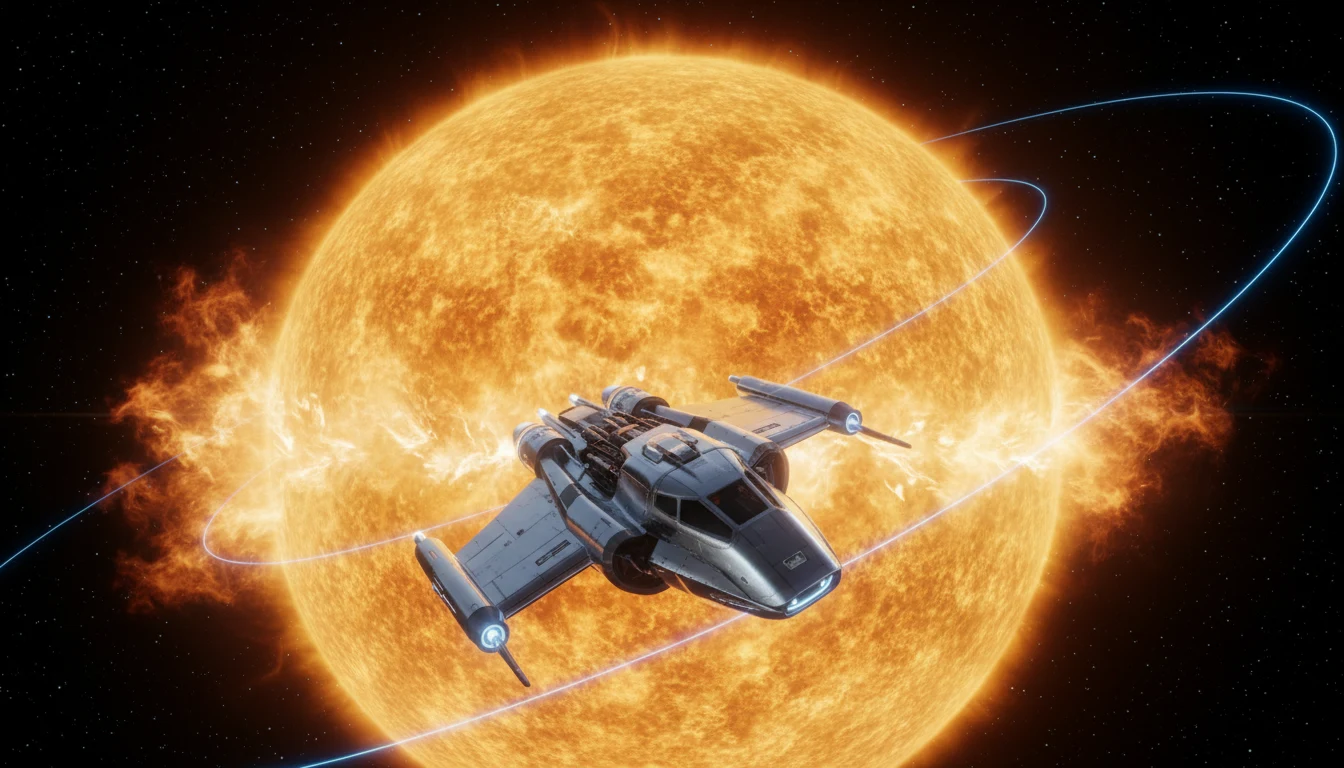
Over the course of three days and roughly a billion processed tokens, the AI generated a highly creative orbital maneuver that human engineers hadn't considered. The AI suggested plunging the spacecraft remarkably close to the sun—closer than the orbit of Mercury. By firing its engines at this perilous proximity, the craft’s solar panels would harvest four times the normal light. Furthermore, executing a burst of thrust while moving at peak speed near a massive gravity well drastically multiplies energy efficiency. This elegant "sun-slingshot" maneuver meant the spacecraft could remain incredibly light and cheap.
Yet, this breakthrough wasn't a solo act by the machine. PSI noted that while the AI is a powerhouse at crunching simulations, it entirely lacks scientific "taste." It doesn't instinctively know which problems are interesting or when it’s chasing a mathematical dead end. A human astrophysicist had to carefully steer the model, ensuring it met mission constraints and didn't hallucinate the physics.
Beyond the engineering triumph, the mission carries profound philosophical weight. It directly confronts the Fermi Paradox—the famous question of why, in a vast and ancient universe, we haven't seen signs of other intelligent life. If humanity successfully launches this probe, we prove that interstellar outreach is both technologically possible and desirable for a civilization. It suggests that the silence of the cosmos isn't due to the impossibility of space travel, but perhaps something far more mysterious. And as we reach out into that quiet dark, we are now doing so with a synthetic mind as our co-pilot.
Key Points
- The Fermi Explorer Mission aims to send a $15 million probe to Alpha Centauri by 2029, accepting an 80,000-year travel time.
- An AI system named 'Get Physics Done' solved a critical power-to-weight engineering puzzle in just three days.
- The AI's solution involves a daring close-approach to the sun to maximize solar energy and thrust efficiency.
- While highly capable of running simulations, the AI still requires human oversight to provide scientific judgment and avoid dead ends.
- The mission serves as a practical test of the Fermi Paradox, proving that civilizations can indeed attempt interstellar travel.
Why It Matters
This demonstrates AI's leap from generating text to solving hard, real-world physics problems, acting as a collaborative partner that can see past human engineering biases.
Sources:
- How AI plotted an interstellar journey to Alpha Centauri — MIT Technology Review - AI
更多专栏

Your Next Coworker is a Blob That Orders Burritos
For decades, enterprise software has been synonymous with sterile dashboards, en...

The Midnight Bill: Why AI Agents Demand Hard Budget Caps
The dream of artificial intelligence is to have a tireless digital assistant wor...
Beyond Transformers: How Mamba is Rewriting the Rules of AI Memory
Think about how a human reads a sprawling, thousand-page fantasy series. You don...