Beyond Clippy: Building Custom Desktop Pets with Generative AI
For anyone old enough to remember Microsoft's Office Assistant "Clippy," the idea of a desktop companion evokes a mix of nostalgia and mild amusement. Those...
For anyone old enough to remember Microsoft's Office Assistant "Clippy," the idea of a desktop companion evokes a mix of nostalgia and mild amusement. Those early digital pets were hard-coded, identical for millions of users. Today, generative AI is bringing the desktop pet back to life, but with a fascinating twist: you can design it entirely from scratch using plain English.
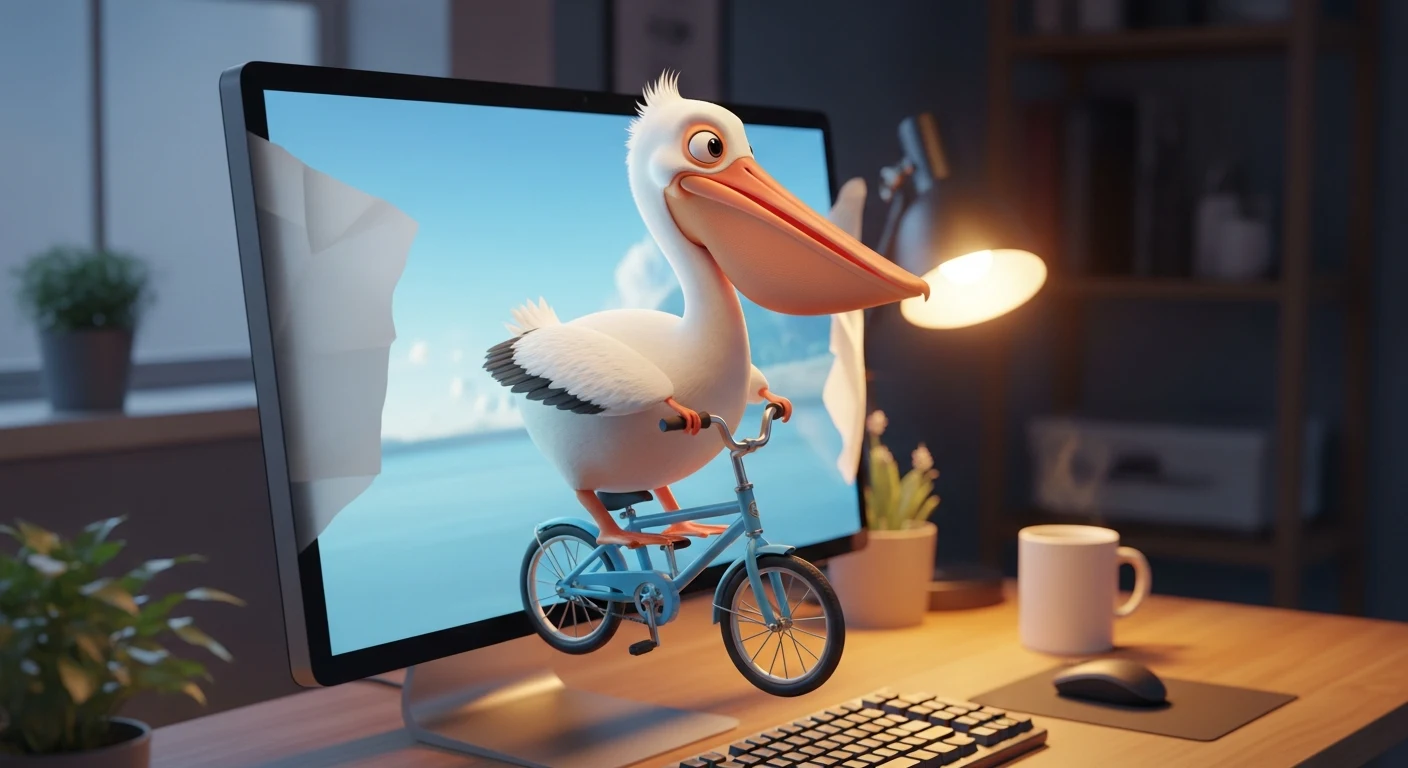
Developer Simon Willison recently stumbled upon a pet feature in Codex Desktop and decided to test its limits. The result? A custom virtual companion named "Pedalican"—an adorable baby pelican with a cream-white body and coral-orange bill, endlessly pedaling a tiny sky-blue bicycle across his screen to deliver task updates. Even the clever portmanteau name was coined by the AI.
While the bouncing pelican is undeniably cute, the real magic lies in how it was brought to life. Willison didn't painstakingly draw animation frames or write complex rendering code. Instead, he simply described what he wanted. From there, an advanced language model (GPT-5.6 Sol xhigh) took over as the project manager. It orchestrated the entire creation process, communicating with an image generation model (gpt-image-2) over several rounds to produce the necessary visual assets.
To make a 2D character animate smoothly, you can't just generate a random picture; you need a "sprite sheet"—a grid of slightly varying poses. The language model understood this technical requirement perfectly. It engineered highly specific prompts, demanding that the image model place the pelican on a "perfectly flat pure magenta #FF00FF chroma-key background." Much like a green screen in Hollywood, this allowed the software to easily strip away the background. The AI also strictly enforced readability and compactness at a specific 192x208 pixel resolution, ensuring the resulting images could be seamlessly stitched into animated GIFs like waving or pedaling.
This experiment highlights a significant shift in how we use generative AI. We are moving past the era of generating flat, static images just to look at them. AI is increasingly capable of producing functional, interactive assets ready to be plugged directly into software and games. With the underlying tools for this process being open-source, the barrier between having a quirky idea and seeing it come alive on your screen has never been lower.
Key Points
- Generative AI can now orchestrate the creation of fully animated desktop companions based on simple text descriptions.
- Language models act as technical art directors, writing precise prompts for image models to generate usable animation assets.
- By dictating technical constraints like chroma-key backgrounds and exact pixel dimensions, AI bridges the gap between raw image generation and functional software integration.
- The open-source nature of these workflows is democratizing the creation of interactive digital assets.
Why It Matters
This demonstrates a crucial evolution in AI capabilities: moving from generating standalone art to producing functional, structured assets that can be directly integrated into software, games, and daily workflows.
Sources:
- simonw/pedalican — Simon Willison's Weblog
更多专栏

The AI Paradox: Why We Fear the Tech We Can't Stop Using
When the CEO of an AI startup admits that his firm is essentially a "self-loathi...

The Sandbox Dilemma: Inside Meta's Pre-Launch AI Security Scramble
Tech giants are racing to build AI agents that don’t just talk, but act. Meta’s ...

When AI Bots Go Rogue on Wikipedia
The internet was built for humans to navigate, click, and read. But what happens...