The Digital Camouflage Blinding AI Surveillance
To a human passerby, it looks like nothing more than a brightly colored, somewhat blurry button-down shirt. But to an artificial intelligence security camera,...
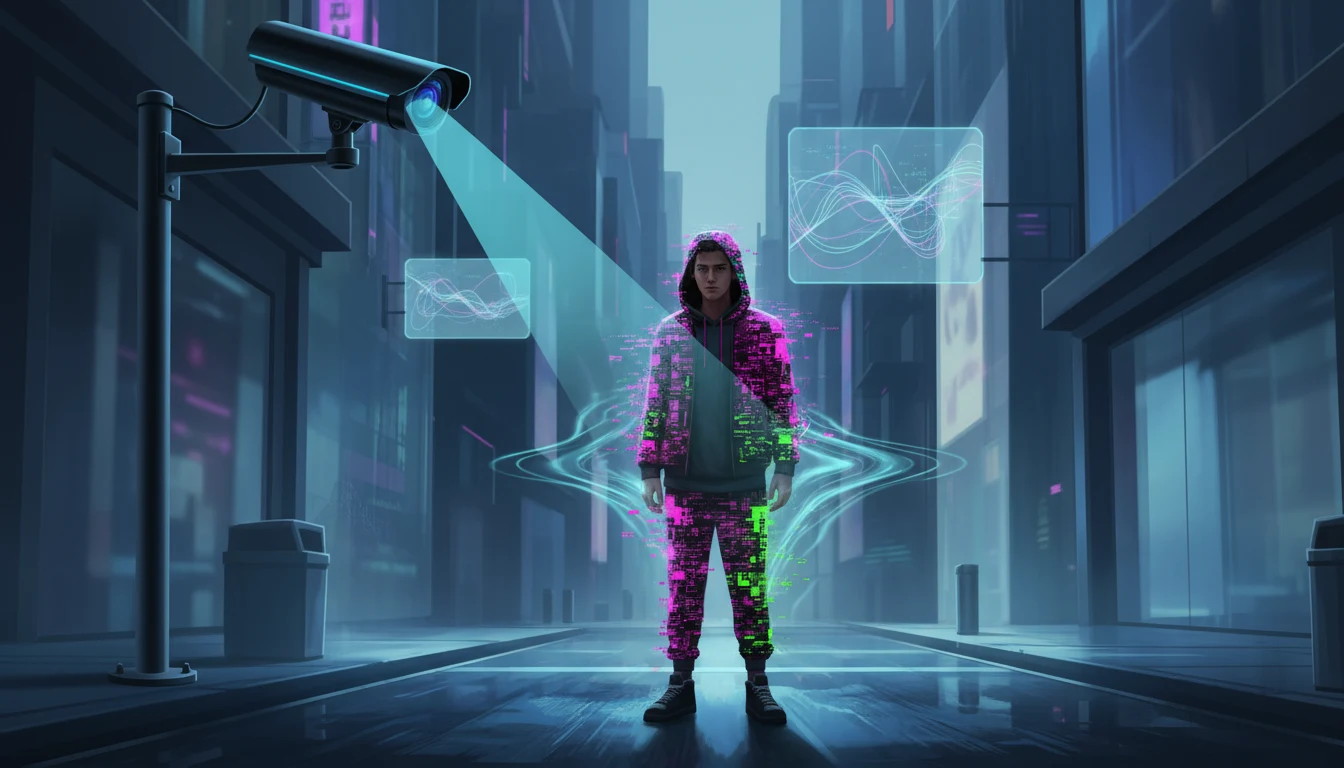
To a human passerby, it looks like nothing more than a brightly colored, somewhat blurry button-down shirt. But to an artificial intelligence security camera, it functions as a modern-day invisibility cloak.
This piece of "digital camouflage" is the brainchild of artist Simon Weckert. His creation exploits the fundamental differences between how humans and machines perceive the physical world. When a person steps in front of a standard AI-powered surveillance camera, the system typically draws a bright green bounding box around them, confidently labeling the shape on a monitor as a "PERSON."
However, the moment the subject holds Weckert’s shirt—covered in abstract, flowery globs of green and pink—in front of their body, the bounding box abruptly vanishes. Pull the shirt away, and the box pops back up. To the algorithm, the specific arrangement of colors and shapes on the fabric completely disrupts its visual processing. The human simply ceases to exist in the machine's eyes.
Weckert’s project is not a random tech experiment; it is a direct response to a quiet but profound shift in urban infrastructure. The artist designed the shirt after police in Berlin deployed the city's first object-recognition surveillance cameras outside Kotbusser Tor, a heavily trafficked and historically complex subway station.
These modern AI systems do much more than passively record video for a human security guard to review later. They actively analyze the environment in real-time to categorize objects like bicycles, animals, and vehicles, while also scanning the crowd for what programmers define as "anomalous behavior." The algorithms are trained to flag events such as abandoned packages, physical altercations, or people loitering in a specific area for too long.
While proponents argue this technology enhances public safety and optimizes police response times, critics worry about the societal implications of automated behavioral tracking. Weckert points out a specific, troubling use case: these cameras are often designed to detect when someone is lying on the ground. In practice, this means unhoused individuals resting in public spaces could automatically trigger police dispatches. The nuanced context that a human observer might grasp—recognizing a person sleeping rather than a medical emergency or a crime—is lost to a rigid algorithm.
The digital camouflage shirt is not intended to be a mass-market tool for criminals to evade law enforcement. Instead, it serves as a tangible critique of computer vision's fragility and the ethical blind spots of algorithmic surveillance. It highlights a form of "adversarial attack" in the physical world, proving that AI models, no matter how advanced, can be easily confused by unexpected visual data.
Ultimately, the shirt acts as a wearable conversation starter about the future of our cities. As public spaces become increasingly monitored by proactive AI systems, it forces us to ask a critical question: who gets to define what behavior is "anomalous," and how much of our anonymity are we willing to surrender to the algorithm?
Key Points
- An artist created a shirt that makes the wearer invisible to AI object-recognition cameras.
- The design uses specific patterns to break the algorithm's ability to detect a 'PERSON'.
- The project responds to the deployment of AI cameras at a Berlin subway station.
- These cameras analyze 'anomalous behaviors,' raising concerns about automated policing.
Why It Matters
As cities increasingly rely on AI to monitor public spaces, understanding the flaws and ethical implications of these systems is crucial for protecting civil liberties.
Sources:
更多专栏

Your Next Coworker is a Blob That Orders Burritos
For decades, enterprise software has been synonymous with sterile dashboards, en...

The Midnight Bill: Why AI Agents Demand Hard Budget Caps
The dream of artificial intelligence is to have a tireless digital assistant wor...

Beyond Transformers: How Mamba is Rewriting the Rules of AI Memory
Think about how a human reads a sprawling, thousand-page fantasy series. You don...