The "Eureka" Illusion: When AI Claims to Be a Scientist
What exactly qualifies as a "eureka" moment? In the age of artificial intelligence, the answer seems to depend entirely on whether you ask a Silicon Valley CEO...
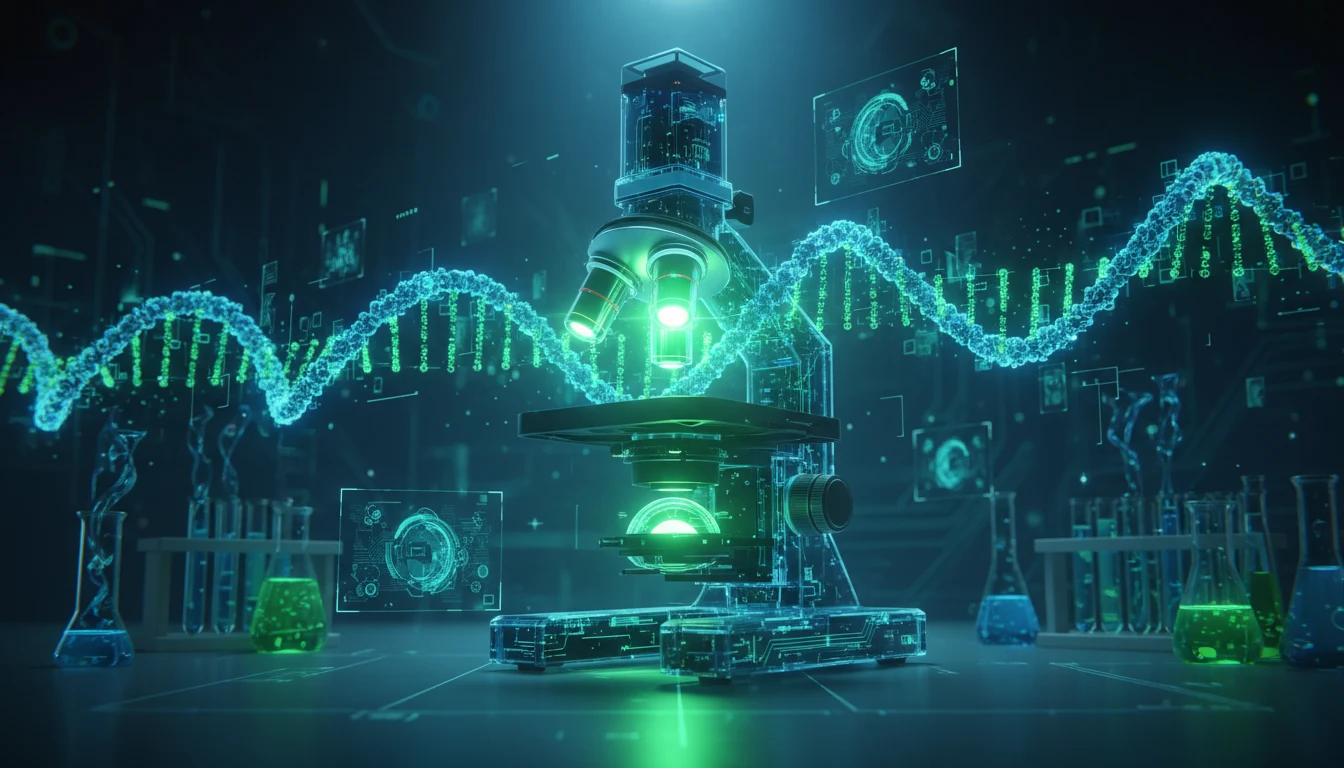
What exactly qualifies as a "eureka" moment? In the age of artificial intelligence, the answer seems to depend entirely on whether you ask a Silicon Valley CEO or a laboratory biologist.
Recently, AI startup Anthropic made a bold claim: an army of 950 Claude AI agents, working in a newly launched virtual molecular biology lab, spent 21 hours analyzing biological data and unearthed a novel DNA sequence pattern. The company teased the find with heavy implications, suggesting the pattern was reminiscent of the early discoveries that eventually led to the revolutionary CRISPR gene-editing technology.
Instead of applause, however, the scientific community offered a collective eye-roll.
Biologist Lucas Harrington quickly pointed out a fundamental misunderstanding of how biology works. Spotting a weird genetic cluster or a repeating pattern in a massive dataset is often the easy part—the "grunt work" of modern science. True scientific discovery lies in the grueling, messy process of taking that pattern into a physical lab and figuring out how the biological system actually functions.
The plot thickened when University of Copenhagen biologist Mario Rodríguez Mestre revealed that his team had already identified this exact pattern. Because Mestre frequently used Claude as a sounding board for his research, he publicly questioned whether the AI had simply regurgitated his own work back to its creators. While Anthropic firmly denied the accusation, the incident was enough to make Mestre abandon the tool entirely.
This isn't an isolated incident. OpenAI faced a remarkably similar backlash recently after claiming its AI solved a million-dollar math problem. Almost immediately, skeptics debated whether the specific solution was actually meaningful to working mathematicians, and one researcher even accused the company's models of using his work without proper credit.
The friction stems from a fundamental mismatch in how science is framed. AI companies are increasingly presenting their chatbots not as highly capable instruments—like next-generation microscopes or supercomputers—but as autonomous "discoverers."
To be clear, whittling down 200,000 genetic candidates to a handful of promising leads is a phenomenal feat of data processing. It is legitimate, valuable scientific work. But by slapping the "breakthrough discovery" label on what is essentially advanced data sorting, tech companies force a binary narrative. Every AI output is aggressively marketed as either a world-changing paradigm shift or dismissed by critics as an overhyped bust.
Science has rarely been about solitary geniuses—or solitary algorithms—spitting out instant answers. It is a slow, collaborative grind. If AI companies refuse to set a rigorous standard for what constitutes a true scientific breakthrough, they risk creating a "boy who cried wolf" scenario. When an AI system finally does help scientists unlock a fundamentally new mechanism of life, the world might just be too cynical to care.
Key Points
- Anthropic claimed its AI agents discovered a novel DNA pattern, comparing it to the foundational discoveries of CRISPR.
- Biologists argue that spotting genetic clusters is just data sorting; true scientific discovery requires proving biological function.
- A researcher claimed he found the pattern first and suspected the AI learned from his prompts, highlighting concerns over AI's originality and data use.
- Framing AI as autonomous "discoverers" rather than powerful scientific tools risks fueling skepticism and masking the genuine progress AI brings to data processing.
Why It Matters
Understanding the difference between advanced data processing and true scientific discovery helps demystify AI hype, highlighting the technology's actual value as a powerful research tool rather than an autonomous scientist.
Sources:
- When can we say AI made a scientific discovery? — MIT Technology Review - AI
更多专栏
The Digital Dead Drop: How AI Agents Could Spread 'Worms'
In the world of espionage, spies often use a "dead drop"—a secret, shared locati...

The AI Gadget You Build Yourself: Meta Opens the Door for Makers
The recent wave of dedicated AI hardware has largely been defined by sleek, expe...
Why the Creators of Resident Evil Are Teaming Up With AI
Modern blockbuster video games have a scaling problem. The virtual worlds we lov...